



Collagen Beyond Skin & Joints: The Benefits You Didn't Know About

TL;DR
Most people associate collagen with skin and joints. But collagen's amino acids, especially glycine, support sleep quality, gut lining integrity, and overall daily recovery. These lesser-known benefits are backed by research and easy to tap into by adding collagen to the foods you're already eating.
What Does Collagen Actually Do Beyond Skin and Joints?
You probably already know collagen supports skin elasticity and joint health. Those are the headline benefits, and they're real. But they're also just the surface. Collagen is the most abundant protein in your body, making up roughly a third of your total protein. It shows up in your gut lining, your tendons, your bones, and the connective tissue holding everything together.
What makes collagen unique isn't just where it works. It's the amino acids it's built from. Collagen has an unusually high concentration of glycine, proline, and hydroxyproline. These three amino acids don't get much attention compared to the leucine and BCAAs that dominate fitness conversations, but they do critical work behind the scenes.
That behind-the-scenes work is what this post is about. If you're already taking collagen for your skin or your knees, you're likely getting benefits you didn't know about. And if you haven't started yet, these might be the reasons that matter most to your day-to-day quality of life.
The Three Amino Acids That Make Collagen Different
Before we get into the specific benefits, it helps to understand why collagen acts differently than other protein sources. It comes down to the amino acid profile.
Glycine
The most abundant amino acid in collagen. Supports sleep, gut lining repair, and acts as a calming neurotransmitter.
Proline
Critical for collagen structure and connective tissue repair. Supports wound healing and arterial health.
Hydroxyproline
Unique to collagen. Stabilizes the collagen triple-helix structure and serves as a biomarker of collagen turnover.
This amino acid profile is what separates collagen from whey, casein, or plant proteins. It's also why collagen isn't a complete protein on its own. It's low in leucine (the amino acid that drives muscle protein synthesis) and missing or low in certain essential amino acids. That's not a weakness when you understand what collagen is designed to do. Collagen excels at supporting connective tissue, gut health, sleep, and recovery. Muscle building just isn't its job.
Collagen supports joints, connective tissue, gut lining, and daily recovery. Whey supports muscle building, fat loss, and post-training recovery. They serve different purposes and work best as teammates, not substitutes.
How Glycine From Collagen Supports Better Sleep
This is probably collagen's most underrated benefit. Glycine, which makes up about a third of collagen's amino acid content, has a direct effect on sleep quality. And not in a vague "promotes relaxation" kind of way. The research here is specific and measurable.
A controlled study published in Sleep and Biological Rhythms found that participants who took 3 grams of glycine before bed experienced reduced daytime fatigue and improved alertness the next day, even under sleep-restricted conditions. The researchers measured both subjective reports and objective cognitive performance, and both improved.
How does it work? Glycine lowers core body temperature at the onset of sleep by increasing blood flow to the extremities. This temperature drop signals your body that it's time to sleep, helping you fall asleep faster and reach deeper sleep stages more efficiently. Glycine also acts as an inhibitory neurotransmitter in parts of the central nervous system, which helps quiet neural activity during the transition to sleep.
A 2024 study in the European Journal of Applied Physiology took this further, specifically testing glycine-rich collagen peptides. Physically active men who took 15 grams of collagen peptides before bed for seven days experienced fewer nighttime awakenings (measured objectively with brain-wave monitoring) and scored better on cognitive tests the next morning.
The practical takeaway: if you're adding collagen to your evening routine, you might sleep better because of it. That's not a stretch claim based on general "wellness" logic. It's a measurable effect of glycine on sleep architecture.
Sleep quality affects everything: recovery from exercise, immune function, mood regulation, appetite control, and cognitive performance. A protein that actively supports better sleep is doing more for your overall wellness than most people realize.
Collagen and Gut Health: Protecting Your Intestinal Lining
Your gut lining is essentially a wall of connective tissue, and connective tissue is collagen's home turf. The cells lining your intestines rely on glycine and proline (both abundant in collagen) for repair and maintenance.
Glycine supports the production of glutathione, your body's primary antioxidant, which helps protect gut lining cells from oxidative damage. It also has anti-inflammatory properties that may help calm irritation in the digestive tract. Animal research has shown that glycine supplementation can help maintain the integrity of the intestinal barrier, the lining that controls what gets absorbed into your bloodstream and what stays out.
This isn't a claim that collagen "heals" gut issues. But the amino acid building blocks in collagen are exactly what your gut lining needs to repair and maintain itself. If your gut lining is constantly turning over and rebuilding (which it is, roughly every 3-5 days), giving it the raw materials for that rebuild is straightforward nutrition science.
For people dealing with the wear and tear of daily stress, imperfect diets, or high training loads, gut lining integrity is a practical concern. It affects nutrient absorption, immune function, and how you feel after eating. Collagen provides the amino acids that directly feed that repair cycle.
Does Collagen Actually Affect Your Brain?
The original version of this post made confident claims about collagen improving cognitive function and mood stability. We need to be more honest about what the science actually says here.
There is a small pilot study (Koizumi et al., 2020) that found collagen hydrolysates improved word recall and verbal learning scores in 30 adults over four weeks. The researchers also observed positive changes in brain structure markers via MRI. But this was an open-label study with no placebo group and a small sample size, funded by a collagen manufacturer. It's interesting, not conclusive.
The glycine-brain connection is real but complex. Glycine acts as a neurotransmitter in the central nervous system, but its effects depend on which receptors it binds to. In some pathways, glycine has a calming, inhibitory effect. In others (particularly at NMDA receptors), it has an excitatory, activating role. A 2023 study published in Science identified a previously unknown glycine receptor (GPR158) in the brain that appears to play a role in mood regulation, but the researchers noted that more work is needed to understand how dietary glycine intake affects this system.
What we can say with confidence: glycine from collagen supports better sleep, and better sleep directly improves cognitive performance, mood stability, and emotional regulation. That's a real pathway from collagen to brain function. It's just an indirect one that runs through sleep quality rather than some direct "brain-boosting" mechanism.
We'd rather tell you the honest version than hype a claim the research doesn't fully support yet. As more studies are published, we'll update this post accordingly.
Collagen and Tendon Health: What Emerging Research Shows
Beyond the well-established joint benefits, there's a growing body of research on collagen's role in tendon health, especially when combined with exercise and vitamin C.
A foundational study from Shaw et al. (2017, American Journal of Clinical Nutrition) demonstrated that consuming vitamin C-enriched gelatin (a collagen derivative) before exercise increased markers of collagen synthesis in the blood. The researchers also showed that serum from participants who consumed gelatin improved the collagen content of engineered ligaments in a lab setting.
Since then, multiple studies have explored collagen peptide supplementation alongside resistance training. A 2024 systematic review and meta-analysis found that prolonged collagen peptide intake combined with exercise was associated with improvements in tendon cross-sectional area and fat-free mass. A March 2026 systematic review in the journal JFunk further examined collagen and vitamin C co-supplementation for tendon outcomes, noting that while results are promising, more controlled trials are needed.
The practical angle: if you're physically active and already taking collagen for your joints, pairing it with vitamin C and taking it before your training sessions may enhance its benefits for your tendons and connective tissue. This is emerging science, not settled fact, but the direction is encouraging.
How to Add Collagen to Your Routine Without Changing Your Routine
One of the biggest barriers to consistent supplementation is inconvenience. If it requires a special shake, a blender, or a completely separate meal, most people won't stick with it.
That's the thinking behind our Meal Boosters line. These are collagen peptides in savory, kitchen-ready flavors designed to mix into food you're already making. Stir them into scrambled eggs, pasta, soup, rice, or anything with heat and moisture. No shaker bottle. No protein bar. No changing your meals.
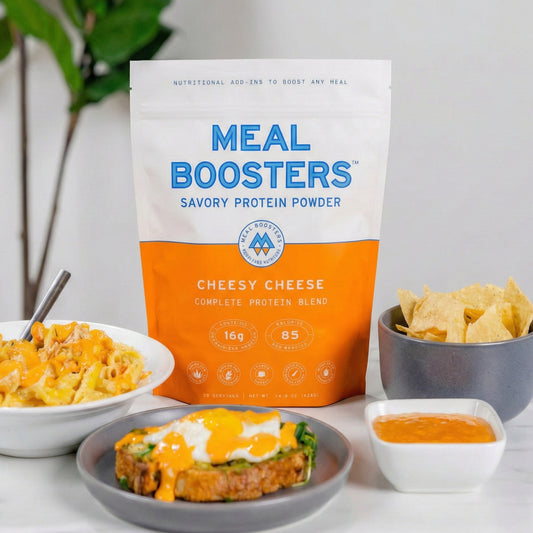
Meal Boosters Cheesy Cheese
Collagen peptides with naturally occurring whey from real aged cheddar. The cheese-based flavors give you a slightly broader amino acid profile than typical collagen supplements, thanks to the small amount of whey that comes naturally from the real cheese powder.
Our cheese-based flavors (Cheesy Cheese, Parmesan, and White Cheddar) contain naturally occurring whey from the real cheese powder used in the blend. That gives them a slightly broader amino acid profile than a pure collagen supplement. They're still primarily collagen products, though. If you're looking for muscle-building protein with a full essential amino acid profile, that's what our Muscle Boosters line (whey isolate + collagen) is built for.
For a no-flavor option, our Unflavored and Buffalo varieties are pure collagen peptides. And Coffee Boosters are designed specifically for your morning cup: unflavored collagen with added pink Himalayan sea salt for hydration, stirred right into your coffee with no taste change.
Many of our customers use Meal Boosters in their daily cooking for the collagen benefits (joints, gut, sleep support) and Muscle Boosters around their training sessions for muscle building and recovery. They complement each other. They're not competitors. They're teammates.
Frequently Asked Questions
Research suggests yes. Glycine, the most abundant amino acid in collagen, has been shown to improve sleep quality by lowering core body temperature at sleep onset and promoting deeper sleep stages. Studies have found reduced daytime fatigue and improved next-day cognitive performance with glycine supplementation before bed.
Collagen provides glycine and proline, two amino acids your gut lining relies on for repair and maintenance. Glycine also supports glutathione production and has anti-inflammatory properties. While collagen won't cure gut conditions, it supplies the building blocks your intestinal lining needs for its constant repair cycle.
The direct evidence is still early-stage. One small pilot study showed improvements in word recall after collagen supplementation, but it lacked a placebo group. What's better supported is the indirect pathway: glycine from collagen improves sleep quality, and better sleep has well-established benefits for cognitive performance, focus, and mood.
No. Collagen is not a muscle-building protein. It's very low in leucine, the amino acid that triggers muscle protein synthesis. Collagen supports joints, tendons, connective tissue, gut health, and skin. For muscle building, you need a whey-based protein with a full essential amino acid profile, which is what our Muscle Boosters line provides.
Most research on collagen benefits uses doses of 5-15 grams per day. For sleep-related benefits, glycine studies typically use 3 grams before bed, which corresponds to roughly 10-15 grams of collagen peptides. Consistency matters more than any single dose.
Emerging research suggests that vitamin C plays a role in collagen synthesis by helping hydroxylate proline and lysine, two amino acids essential for forming the collagen helix. If you're taking collagen for tendon or connective tissue support, pairing it with vitamin C (especially before exercise) may enhance the benefits.
Meal Boosters are primarily collagen peptides in savory flavors, designed for daily cooking. They support joints, skin, gut health, and connective tissue. Muscle Boosters combine organic grass-fed whey protein isolate with collagen peptides, providing a full essential amino acid profile for muscle building and post-training recovery. Many customers use both.
Absolutely. They complement each other. Use Meal Boosters in your daily meals for collagen benefits (joints, gut, recovery, sleep support) and Muscle Boosters around your training sessions for muscle building and workout recovery. Different amino acid profiles, different jobs, same team.
Collagen does more than you think. And you don't need to change your routine to get the benefits.
Sleep quality. Gut integrity. Tendon support. Everyday recovery. Collagen's amino acids work quietly in the background, supporting the systems that keep you feeling good and performing well. Add it to the meals you're already making, and let the science do its thing.